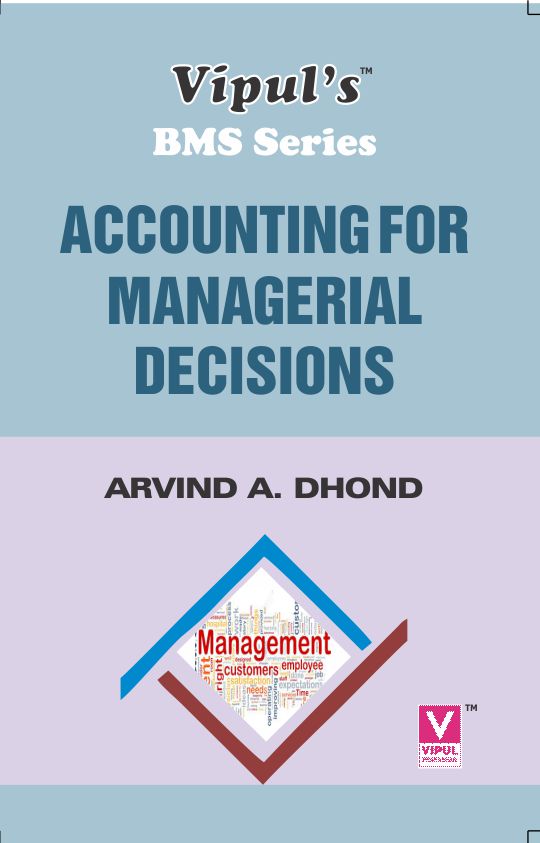
Accounting for Managerial Decisions

(0 customer reviews)
270.00

SYLLABUS

(1)     Analysis and Interpretation of Financial Statements: 

  • Study of Balance Sheet of Limited Companies, Schedule VI (New). Study of Manufacturing, Trading, Profit and Loss A/c of Limited Companies, Schedule VI (New).
  • Vertical Form of Balance Sheet and Profit & Loss A/c – Trend Analysis, Comparative Statement and Common Size.

(2)     Ratio Analysis and Interpretation:

Ratio Analysis and Interpretation (based on Vertical Form of Financial Statements) including Conventional and Functional Classification restricted to:
  • Balance Sheet Ratios: Current Ratio, Liquid Ratio, Stock Working Capital Ratio, Proprietory Ratio, Debt Equity Ratio, Capital Gearing Ratio.
  • Revenue statement ratios: Gross Profit Ratio, Expenses Ratio, Operating Ratio, Net Profit Ratio, Net Operating Profit Ratio, Stock Turnover Ratio, Debtors Turnover Ratio, Creditors Turnover Ratio.
  • Combined Ratios: Return on Capital Employed (including Long Term Borrowings), Return on Proprietors Fund (Shareholder Fund and Preference Capital), Return on Equity Capital, Dividend Payout Ratio, Debt Service Ratio.
  • Different Modes of Expressing Ratios: Rate, Ratio, Percentage, Number. Limitations of the use of Ratios.

(3)     Cash Flow Statement:   

Preparation of Cash Flow Statement (Accounting Standard - 3 (Revised)).

(4)     Working Capital:                   

  • Working Capital: Concept, Estimation of Requirements in Case of Trading and Manufacturing Organisations.
  • Receivables Management: Meaning and Importance, Credit Policy Variables, Methods of Credit Evaluation (Traditional and Numerical – Credit Scoring); Monitoring the Debtors Techniques [DSO, Ageing Schedule].
SYBMS — SEMESTER – III

Author: Arvind A. Dhond

SIXTH EDITION

Description

SYLLABUS

(1)     Analysis and Interpretation of Financial Statements: 

  • Study of Balance Sheet of Limited Companies, Schedule VI (New). Study of Manufacturing, Trading, Profit and Loss A/c of Limited Companies, Schedule VI (New).
  • Vertical Form of Balance Sheet and Profit & Loss A/c – Trend Analysis, Comparative Statement and Common Size.

(2)     Ratio Analysis and Interpretation:

Ratio Analysis and Interpretation (based on Vertical Form of Financial Statements) including Conventional and Functional Classification restricted to:

  • Balance Sheet Ratios: Current Ratio, Liquid Ratio, Stock Working Capital Ratio, Proprietory Ratio, Debt Equity Ratio, Capital Gearing Ratio.
  • Revenue statement ratios: Gross Profit Ratio, Expenses Ratio, Operating Ratio, Net Profit Ratio, Net Operating Profit Ratio, Stock Turnover Ratio, Debtors Turnover Ratio, Creditors Turnover Ratio.
  • Combined Ratios: Return on Capital Employed (including Long Term Borrowings), Return on Proprietors Fund (Shareholder Fund and Preference Capital), Return on Equity Capital, Dividend Payout Ratio, Debt Service Ratio.
  • Different Modes of Expressing Ratios: Rate, Ratio, Percentage, Number. Limitations of the use of Ratios.

(3)     Cash Flow Statement:   

Preparation of Cash Flow Statement (Accounting Standard – 3 (Revised)).

(4)     Working Capital:                   

  • Working Capital: Concept, Estimation of Requirements in Case of Trading and Manufacturing Organisations.
  • Receivables Management: Meaning and Importance, Credit Policy Variables, Methods of Credit Evaluation (Traditional and Numerical – Credit Scoring); Monitoring the Debtors Techniques [DSO, Ageing Schedule].
Narayan Niwas, 161,
Jagannath Shankar Seth Road,
Girgaum, Mumbai 400 004. Maharashtra, INDIA.

Need Help

Monday – Saturday: 10:30AM to 07:00PM

info@vipulprakashan.com

© Copyright 2025 Vipul Prakashan – All Rights Reserved – Powered by MTech